CRCQL’s Eddystone Community Meeting featured in Sunday Delco Times
Community meeting to be held in Eddystone regarding potential LNG terminal
By Kathleen E. Carey | [email protected] | delcotimes.com
PUBLISHED: February 21, 2026 at 7:30 AM EST | UPDATED: February 21, 2026 at 4:40 PM EST
A community meeting is being held Sunday afternoon in Eddystone to discuss a proposal for a liquefied natural gas terminal in the borough as environmental advocates are concerned about the impacts such a facility could have.
At 2 p.m. Sunday, the Delaware Riverkeeper Network with support from Chester Residents Concerned About Quality Living are hosting Community Info Session at the Joe Hughes Memorial Hall, 1112 E. Seventh St. in Eddystone.
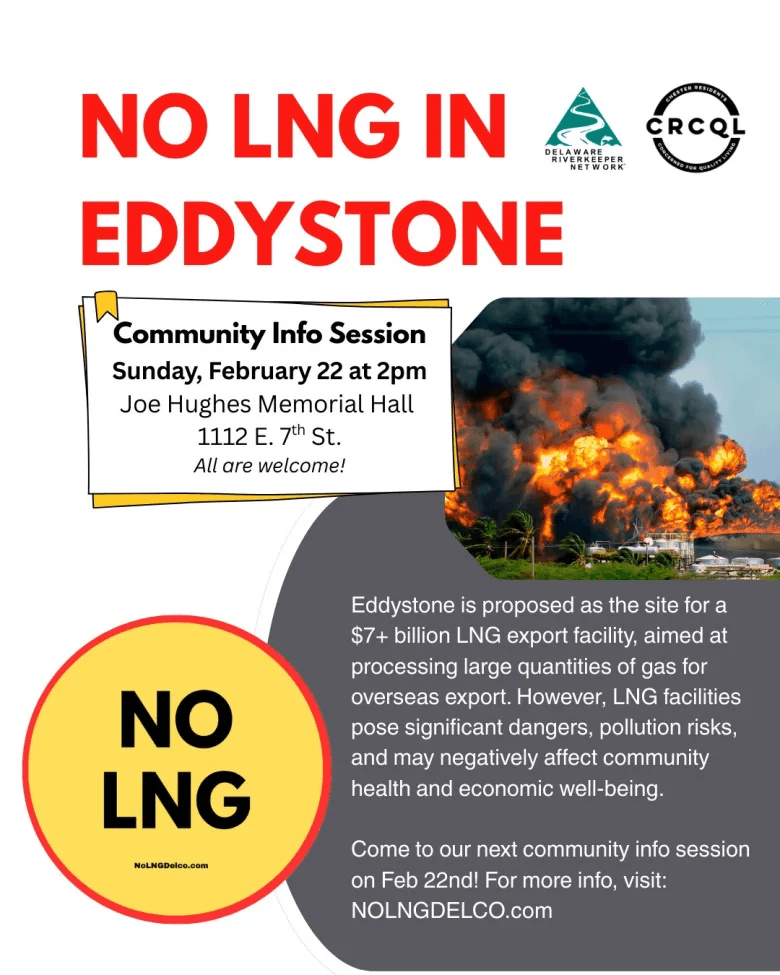
The public is welcome to attend.
“There’s no room. There’s no room in Eddystone for LNG,” Tracy Carluccio, deputy director of Delaware Riverkeeper Network, said. “If LNG were to be exported from a facility on the Delaware River using shale gas from Pennsylvania, it would have very negative impacts.”
According to Chester Residents Concerned for Quality Living, CRCQL, the Delaware County riverfront is being evaluated as the site of a potential $7 billion LNG terminal by Penn America/Eddystone Energy LLC and it would process 1 billion cubic feet of gas daily on a 60-plus acre site to export overseas.
In an April 2025 Washington Times column, U.S. Sen. Dave McCormick, R-Pa., wrote, “Penn America Energy and the Pennsylvania Building Trades are collaborating on a $7 billion project to build a new LNG export terminal along the Delaware River in Eddystone.”
Members of Eddystone Borough Council and the borough manager did not respond to multiple requests for comment.
Justin Backover, spokesman for the state Department of Community and Economic Development, did not respond to specific questions about an LNG terminal along the Delaware River. However, he did issue a statement.
“DCED routinely discusses potential projects with companies seeking to do business in the Commonwealth,” it read. “Often, these discussions are confidential, because they involve confidential or proprietary information from the company, preventing DCED from disclosing information. Maintaining confidentiality in such discussions is common practice in the business development industry across the country. DCED is committed to engaging with the local community and stakeholders regarding proposed economic development projects, including any proposed energy projects.”
An email sent to Penn America Energy was returned and other emails sent to individuals associated with the proposal received no response.
Earlier this month, CRCQL and the Delaware Riverkeeper Network held a webinar about the liquified natural gas processing and export terminal proposed for Eddystone. They’ve also set up a website at nolngdelco.com.
At the webinar, Carluccio spoke about how Delaware County’s riverfront is being eyed for such a project.
“First in Chester, now in Eddystone but maybe they’ll go back to Chester, maybe they’ll go to Eddystone, maybe they’ll go to Philadelphia. We really don’t know but at this point, they’re saying Eddystone,” she said.
Penn America Energy had been looking to build an LNG terminal in Chester.
In 2024, then President Joe Biden paused all pending approvals of LNG terminals due to a potential link to climate change. When the administration changed, President Donald Trump reversed the pause.
Advocates say the project has changed names but not the players.
“Eddystone Energy LLC, that’s what they’re calling it,” Zulene Mayfield, founder of CRCQL, said. “It’s one in the same:– Penn America.”
According to the environmental advocates, Franc James, CEO of Penn America Energy, created Eddystone Energy LLC last year and has engaged in non-disclosure agreements with both the state DCED and Eddystone officials.
Emails sent to James received no response. DCED issued the statement and Eddystone officials did not respond to requests for comment.
At the CRCQL/Delaware Riverkeeper Network webinar, Carluccio explained that liquefied natural gas is natural gas that is cooled down to a liquid state about minus 260 degrees. She said about 95% of LNG is methane.
“The volume of natural gas in its liquid state is about 620 times smaller than its volume than when it’s a gas,” she said, adding that this makes it easier to transport. “It also makes it more explosive, more dangerous.”
Carluccio said it’s primarily made to export overseas, where it is regassified and used as an energy source, primarily to make electricity.
“These operations are very dangerous,” she added, noting that the gas is colorless and odorless and turns into a vapor cloud when it hits the atmosphere.
She added that it can be trapped in basements and it’s highly flammable, ignited by a spark.
Carluccio said should a fire occur, workers and nearby residents have minutes to evacuate and the fire would be left to burn.
“Here in our area, we have no LNG export facilities at all and that means that we are not trained,” she said. “We don’t know much about it. Our emergency responders, our fire companies don’t have the equipment. We’re just not equipped to handle anything that would come along with trying to manage a very dangerous and flammable explosive operation like this.”
She noted that the federal government recommends these facilities be placed in remote locations, not densely populated spots.
The webinar also addressed pollution, saying the facility and its processing would result in particulate matter, nitrogen oxide, sulfur dioxide, volatile organic compounds, ammonia, sulfuric acid and other chemicals that could impact health with respiratory problems and other conditions.
“We already have too much NOx, too much VOCs,” Carluccio said. “We cannot take another drop of it.”
She added that a dock would have to be built to accommodate these ships.
“We don’t really know if they would have one berth or two berths,” Carluccio said. “There’s very little information. We’ve been fighting to get information about this project and they’ve been keeping it behind closed doors.”
She also spoke of the size of the ships carrying these materials.
“The ships that would carry the LNG are larger than any marine vessels that come up this far in the Delaware River now,” Carluccio said. “This is a whole new ballgame. These are enormous. They’re so big that if you were to calculate … the power of one of those ships blowing up filled with LNG, it would equal the power of 68 Hiroshima bombs, and we’re talking about having that here on the Delaware River.”
As a contrast, the Delaware Riverkeeper Network said the length of the LNG ships to be used for the proposed Gibbstown LNG terminal would be the same or similar to those in Eddystone and would be up to 966.2 feet long and 152.2 feet wide.
The LNG ships being used in Marcus Hook at Sunoco Logistics/Energy Transfer’s terminal are 590 feet long and 85 feet wide, she added.
Carluccio also said in the webinar that most LNG processing terminals are 1,000 acres large. Eddystone, she said, was 1 mile square and Penn Terminals, which is located in Eddystone, by comparison is 95 acres.
She added that such a facility would result in domestic natural gas and electric prices going up.
Mayfield said an LNG facility doesn’t create many permanent jobs and those that are there require five years of experience at an LNG facility. She said often workers are migrated to operate and run these facilities.
“It would not be economic gain for Delco or this immediate area,” she added.
James Hiatt of For a Better Bayou shared his experience of living in an area in Louisiana where there are three operating LNG terminals with plans for more.
He told the audience about a Feb. 3 pipeline explosion in Cameron Parish in which one worker was injured and is now suing the company, Delfin LNG, for more than $1 million alleging that “unsafe conditions” led to “catastrophic personal injuries.”
Hiatt said the companies will say these projects are about economic prosperity and jobs.
“There’s no prosperity,” he said. “They export them profits just like they export the gas. It doesn’t stay in the community.”
In November, state Rep. Greg Vitali, D-166, of Haverford held a state House Environmental & Natural Resource Protection Committee hearing at Chester City Hall to hear about the potential health, environmental and ratepayer impacts of an LNG terminal in southeastern Pennsylvania.
“While Pennsylvania has been a large producer of shale gas, the climate impact outweighs the returned economic value,” Vitali said at the time. “The testimony that we’ve heard today supports the point that even though the industry touts natural gas as a solution to climate change versus coal and oil, LNG is actually one of the most polluting forms of energy when the full supply chain is taken into account.”
He was hosting the hearing due to the speculation of Chester, Eddystone and Marcus Hook being possible locations for Penn America Energy to build an LNG export terminal designed to accommodate large LNG carrier ships.
He also noted that these areas are designated as environmental justice areas because of the air, land and water pollution burden they already have.
Carluccio testified at that hearing, saying, “Natural gas is classified as a hazardous substance and carries never-ending safety threats. There were 108 pipeline safety incidents in Pennsylvania from 2010 into 2018, causing eight fatalities and $66.9 million in property damage. It’s clear this project is not clean, not carbon neutral, is unsafe, and the company has not interfaced with the people who would be most impacted.”
Read original article here: https://www.delcotimes.com/2026/02/21/community-meeting-to-be-held-in-eddystone-regarding-potential-lng-terminal/